

Wisconsin’s Wolf Fight: A Grassroots Battle for Hunters’ Voices and Wildlife Balance
Why Every Hunter Nation Member Must Step Up Now Before Courts, Agencies, and Out-of-State Groups Decide for Us
Many people outside hunting see wolf management as a small policy issue. In Wisconsin, it is much bigger. It tests whether hunters, landowners, and rural families still have a real voice in wildlife decisions. Or if that power has shifted more to federal courts, endless lawsuits, vague agency rules, and activist campaigns from outside the state.
This comes straight from the recent Outdoor Wild Podcast episode "The Wolf Conflict: Reclaiming Wisconsin's Wild." Guests included Hunter Nation Wisconsin State Director Chris Vaughn, Dick and John Ellis from On Wisconsin Outdoors, Alex Gundrum from the National Deer Association, and host Dean Romano. They explained the high stakes clearly. Wolves belong on the landscape. But they must be managed responsibly to protect deer herds, livestock, pets, hounds, and the hunting traditions that fund conservation.
This fight is not about removing wolves forever. Speakers stressed multiple times that wolves have a place. The real debate is about real management versus letting numbers grow without firm limits or accountability.
The Main Issue: True Management, Not Just Protection
Chris Vaughn and others said it plainly:
"We support wolves, but they need to be managed and not protected anymore."
The goal is balance. Overpopulation harms deer, rural economies, and trust in wildlife agencies.
The Wisconsin DNR reports wolves stay federally protected due to court rulings. This blocks harvests and most lethal controls. The 2023 Wolf Management Plan (approved October 2023) uses "adaptive management" without a hard statewide population goal. Neighboring states set clear targets. Montana aims for about 400 wolves. Wyoming targets 200-300. Idaho aims for 500. Without a firm number in Wisconsin, many hunters see this as drift instead of real management.
Real Impacts on the Ground Build Frustration
The podcast shares stories from the field. Deer herds in northern Wisconsin suffer heavy pressure. Hunter success rates dropped from around 50% in past decades to near zero in some areas. This pushes hunters south and cuts license revenue that funds conservation. Depredations hit hard. Livestock, pets, hounds, and deer face losses. Taxpayers paid over $300,000 in reimbursements in 2024 alone.
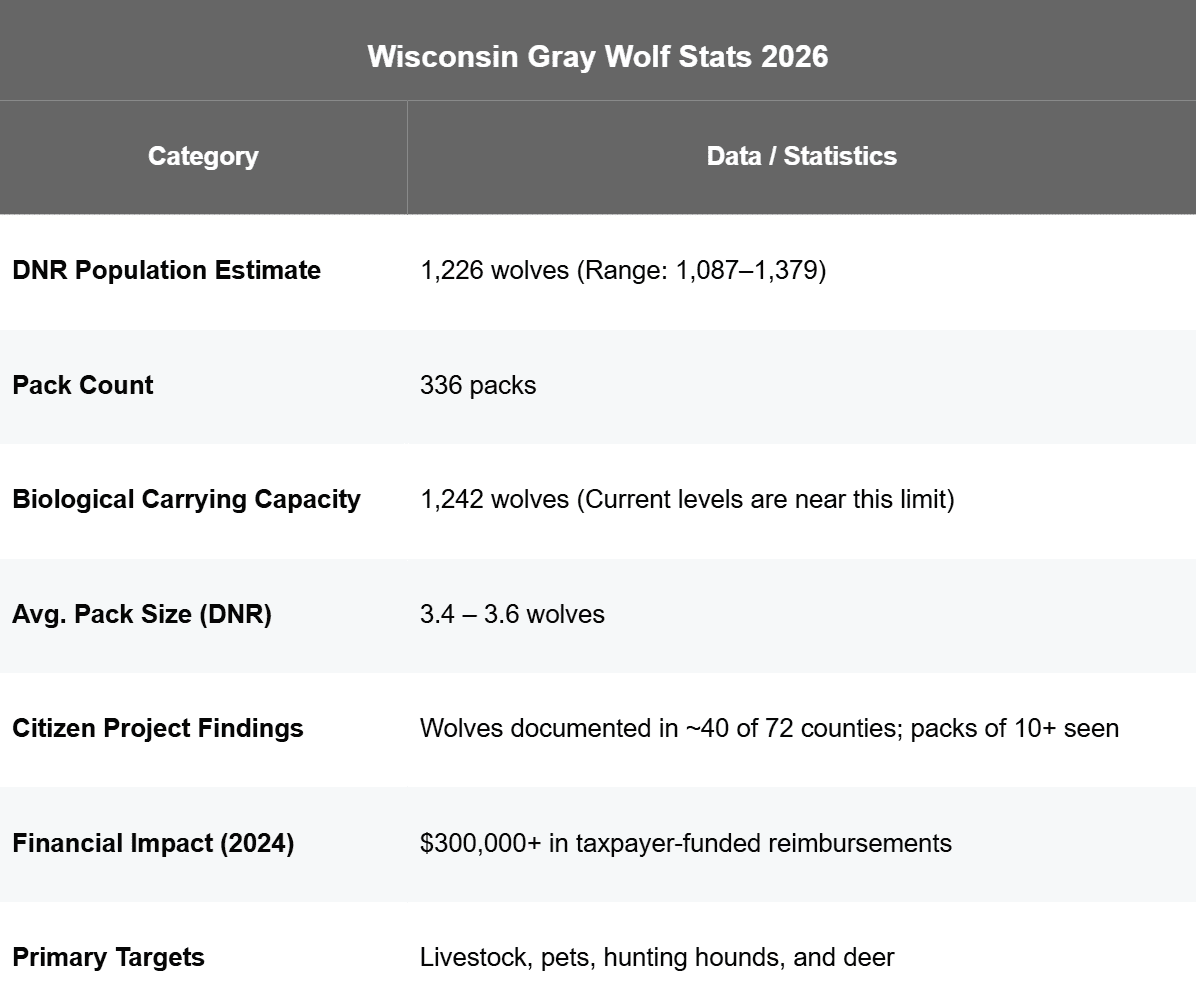
Wolves spread beyond historic ranges. On Wisconsin Outdoors runs a citizen trail-cam project. It documented wolves in about 40 of Wisconsin's 72 counties. Photos show packs larger than DNR averages (3.4-3.6 wolves per pack), with some groups of 10+.
The DNR's latest overwinter estimate (for 2024-2025 monitoring) is 1,226 wolves in 336 packs. The range is 1,087 to 1,379 wolves with 95% confidence. This is down slightly from 1,328 the year before but near the state's biological carrying capacity of 1,242. The estimate covers pack wolves only and comes before spring pups. Speakers argue it undercounts lone wolves and southern spread. One side sees a healthy, stable population needing careful care. The other sees proof the species recovered long ago and needs clear harvest authority.
Federal Delisting Offers the Path to State Control
Federal action matters most now. H.R. 845, the Pet and Livestock Protection Act, passed the U.S. House in December 2025 on a bipartisan vote of 211-204. Sponsored by Reps. Lauren Boebert (R-CO) and Tom Tiffany (R-WI), directs the Interior Secretary to reissue the 2020 delisting rule within 60 days and limits court challenges. The bill went to the Senate in December 2025 and was referred to the Committee on Environment and Public Works. It still needs Senate passage and enough votes to overcome hurdles.
This is bigger than one state or season. It ends the cycle of delist-relist through lawsuits. That cycle makes steady state management impossible. In 2021, after a brief delisting, Wisconsin held a hunt. Hunters took 218 wolves in 60 hours against a 200 quota. Science showed up to 29% removal has no long-term harm. Courts overturned it anyway. Rural communities and hunters felt frustrated.
Why Hunter Nation Members Cannot Ignore This
This connects to everything Hunter Nation fights for:
- Hunting opportunity — Healthy deer herds mean more tags and better success rates.
- Conservation funding — Fewer hunters mean less license money for habitat.
- Landowner rights — Losses to livestock and pets hurt rural life.
- Public trust — Vague plans and federal overrides ignore those who live with wildlife and pay for it.
Chris Vaughn pointed out a key problem. Many licensed hunters do not vote regularly. Yet elections shape agencies, Congress, and policy. Hunter Nation's "Hunt the Vote" work has turned out thousands of inactive voters. It shows grassroots effort wins.
Practical Steps for Grassroots Action Right Now
Here is what works:
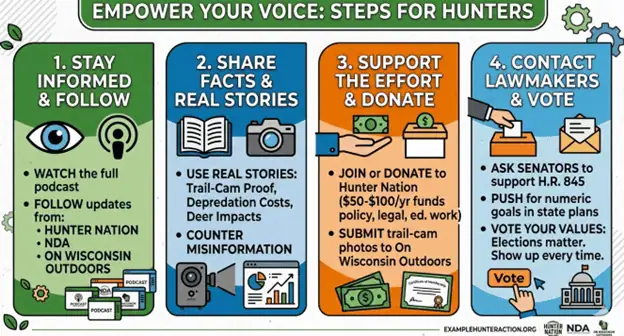
- Stay informed. Watch the full podcast. Follow Hunter Nation, NDA, and On Wisconsin Outdoors for updates.
- Share facts. Use real stories: trail-cam proof, depredation costs, deer impacts. Counter misinformation.
- Support the effort. Join or donate to Hunter Nation. Even $50-$100 per year funds policy, legal, and education work. Submit trail-cam photos to On Wisconsin Outdoors.
- Contact lawmakers. Ask your senators to support H.R. 845. Push for numeric goals in state plans.
Vote your values. Elections matter more than any single season. Show up every time.
What to Know: Key Facts on Wisconsin's Wolf Challenge
- Population: 1,226 wolves (DNR 2024-2025 estimate) in 336 packs. Range: 1,087-1,379 with 95% confidence. Near carrying capacity of 1,242.
- Impacts: Heavy deer declines. Over $300,000 in depredation costs in 2024. Growing conflicts with pets and livestock.
- 2023 Plan: No firm statewide cap. Uses "adaptive" zones but seen as too vague by many.
- Federal Bill: H.R. 845 passed House (211-204 in December 2025). In the Senate now. Aims to delist wolves and reduce court overrides.
- Hunter Nation View: Pro-wolf and pro-management. We want balance for healthy ecosystems, strong deer herds, and rural communities.
Wolf policy is not separate from the bigger fight. It tests if hunters who know the land best can keep their seat at the table. Hunter Nation members understand this. Now is the time to act: get informed, mobilize others, donate, contact lawmakers, and vote consistently.
Take Action Today: Join Hunter Nation, make a donation, and reach out to your senators about H.R. 845. Visit http://hn2.southmulberry.com to start. The push for responsible wildlife management begins with you.