

What Hunters Really Think About CWD
Chronic wasting disease is reshaping how wildlife agencies manage deer, but the people living with it every season are hunters. Here’s what hunters are seeing in their herds, how they’re adapting, and what they want from policies written in CWD’s name.
At Hunter Nation, We Listen to Hunters
At Hunter Nation, we exist to be the united voice of the American hunter and to protect our hunting lifestyle, heritage, and traditional American values.
CWD is real, always fatal to infected deer, and a growing concern for wildlife professionals. But it is hunters who are on the front lines: buying licenses, funding conservation, pulling CWD samples, and watching how disease, weather, predators, and habitat come together in their local woods. Any honest conversation about CWD has to start with what they see and feel in the field.
Two Diseases, One Big Confusion: EHD vs CWD
Spend any time around a skinning shed or check station and you’ll hear two diseases mentioned in the same breath: epizootic hemorrhagic disease (EHD) and chronic wasting disease (CWD). Hunters often lump them together, but they behave very differently.
EHD is the hammer blow. In bad years, it can wipe out big portions of a local whitetail herd in a matter of weeks. Deer spike high fevers, suffer internal bleeding, and often die near water. Some outbreaks have killed well over half of the deer in small areas in a single season. EHD can wipe out local herds in weeks.
CWD is a slow burn. It is always fatal, but it spreads more gradually. Infected deer can look perfectly normal for much of the disease course, only showing classic symptoms—weight loss, drooling, loss of coordination, odd behavior—late in the game. CWD is always fatal, but spreads slowly.
That contrast drives a lot of hunter sentiment. EHD is the disease many hunters see wiping out the deer on their farms and leases right now. CWD is the disease they hear about on the news.
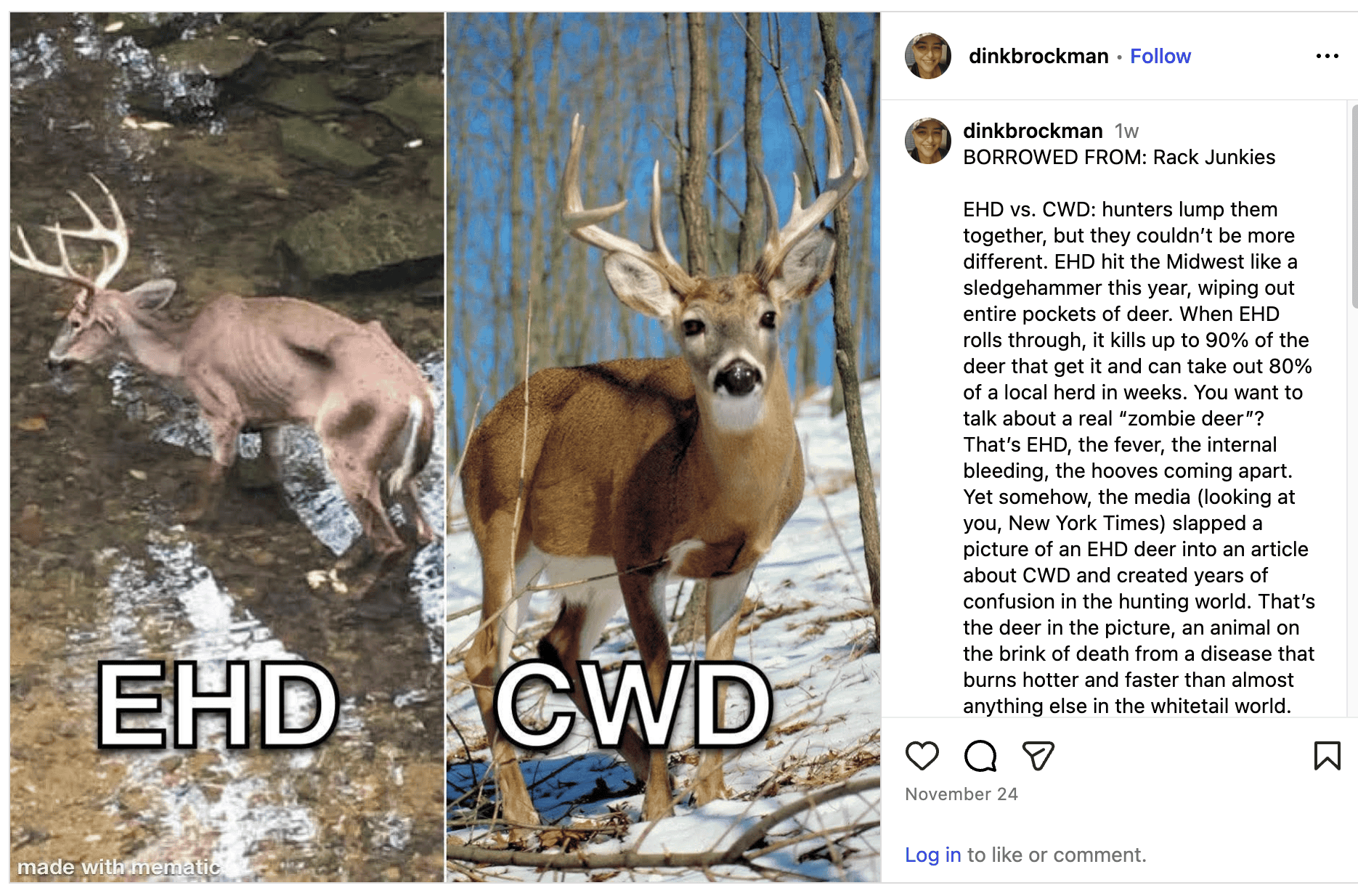
National media often lean on “zombie deer” headlines and dramatic photos when they talk about CWD, even though the most grotesque images usually resemble acute EHD cases more than typical CWD.
So it’s no surprise that many hunters are asking a fair question:
If EHD is the disease that empties the woods in a single summer, why does CWD dominate the headlines and the funding?
From the Stand: Concerned, But Not United
When you look at survey work instead of just social media, you see a consistent pattern: hunters know about CWD and many are concerned, but they are not united.
Research tracking Maryland hunters over eight years found that hunters tend to fall into three broad groups:
-
A low-risk group that accepts CWD exists but isn’t personally worried.
-
A moderate-risk group that is cautious about both deer and human health but keeps hunting.
-
A smaller high-concern group that sees CWD as a serious threat to both deer herds and venison safety.
A 2020 Cornell University study of New York hunters found that most hunters have heard of CWD and believe it can harm deer, but many are uncertain about human-health risk and continue to eat venison from CWD areas if they have done so for years without problems.
The reality on the ground looks something like this:
-
Hunters are not ignoring CWD. They are hearing about it, talking about it, and in many cases changing how they handle deer.
-
They are divided on how big a threat it really is. Some see CWD as an unfolding crisis; others see it as one more challenge in a long list that deer have always faced.
-
They are willing to adapt—but only so far. Many will get deer tested or alter where they hunt; far fewer are willing to hang up their rifles and bows because of CWD alone.
That nuance often gets lost in public debate, which tends to swing between panic and dismissal. Hunters are living in the gray zone in between.
New Rules, New Friction: How CWD Is Changing the Hunt
CWD has changed what hunters talk about, but it has also changed how they are allowed to hunt and what happens after the shot.
In Washington state, for example, detection of CWD in wild deer triggered a set of new rules in 2025: a statewide ban on feeding and baiting deer, elk, and moose, restrictions on some urine-based lures, and tighter carcass-movement and disposal requirements in high-risk areas.
In Iowa, hunters can use a “hunter submission pathway” to have their deer tested for CWD by the state diagnostic lab, but if they use that option outside of routine surveillance programs they pay a testing fee of about $25 per deer and handle sample collection and shipping themselves.
Across the country, CWD rules tend to include:
-
Mandatory or strongly encouraged testing in CWD zones.
-
Bans on moving whole carcasses across certain county or state lines.
-
Feeding and baiting restrictions to reduce deer congregation.
-
Strong instructions on how and where to dispose of carcass waste.
From a wildlife-management perspective, these are tools to slow a tough disease. From a hunter’s perspective, they can feel like friction:
More regulations to track, more steps to take after the shot, and in some cases more out-of-pocket cost—layered on top of license fees that already fund wildlife management.
Many hunters will do their part when they believe the rules are practical, rooted in real biology, and likely to help. But when rules feel constantly changing, hard to understand, or disconnected from the reality they see in their woods, cooperation and trust start to erode.
What’s Really Happening to Deer Herds?
At the individual level, there is no debate: CWD is always fatal to infected deer, and there is no vaccine or cure on the horizon.
At the herd level, the picture is more complicated.
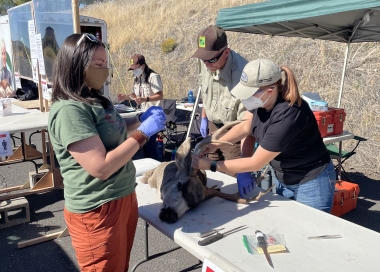
Long-term studies in Western mule deer have shown that herds with high CWD prevalence can experience real, measurable declines over time. In some populations, adult survival and population growth are lower in CWD-endemic herds than in nearby herds without the disease. Studies in Western mule deer show declines in high-CWD herds.
But in many whitetail areas—especially in parts of the Midwest—state agencies report that overall deer numbers and hunter harvests remain strong, even after years of documented CWD cases. Wisconsin has battled CWD for decades and still reports strong harvests in many units, and many hunters there still report full deer woods and successful seasons, even as prevalence increases in some local pockets.
That feeds two competing storylines in camp:
-
One view says CWD is a slow-burn crisis that will, over decades, erode age structure and herd quality if left unmanaged.
-
Another says, “We’ve had CWD for years and still see plenty of deer—maybe the response has been more damaging than the disease.”
Both contain parts of the truth. The challenge is acknowledging the long-term biological risk and the lived reality that many hunters still see healthy, huntable deer every season.
Big Money for CWD: Hunters Want Balance
From Washington, D.C. down to county conservation boards, CWD is now a serious budget line.
USDA’s Animal and Plant Health Inspection Service (APHIS) recently announced more than $11 million in new funding in 2025 alone for CWD surveillance, research, and management across wild and farmed cervids. Over the past several years, the program has directed over $40 million toward CWD-related projects.
Those dollars support important work: better diagnostic tests, improved surveillance, and stronger coordination between wildlife and agriculture agencies.
But from the perspective of hunters watching their local woods, the picture can look different. They may see EHD kill half the deer on a small river bottom in one scorching summer, while the most visible attention and money continue to flow to CWD. EHD events wiping out local herds in a single summer are burned into their memories.
Hunters are not opposed to serious funding for serious disease. They simply want to know:
-
Are dollars and regulations aimed at CWD actually aligned with what is hitting local herds the hardest?
-
Are we investing in strategies that protect both deer populations and long-term hunter participation?
Those are fair questions—and they deserve clear, honest answers.
What Hunters Say They Need from CWD Policy
Across surveys and everyday conversations, several themes keep coming up when hunters talk about CWD policy.
-
Straight facts, not fear.
Hunters want clear explanations of what we know and don’t know about CWD in deer and people—without hype. They turn off when they see “zombie deer” headlines and simplistic worst-case scenarios. Surveys show hunters want clear, honest information rather than sensationalism. -
Simple, stable rules that make sense.
Support for management actions is highest when rules are easy to understand, clearly connected to the biology of CWD, and don’t change every season. Confusing or constantly shifting regulations drive frustration and non-compliance, even among hunters who accept that CWD is real. Support is highest when rules are simple and stable. -
A real seat at the table.
Research repeatedly shows that trust in the state wildlife agency is the strongest predictor of support for tough CWD measures like culling, baiting bans, or strict carcass rules. When hunters feel heard and included in decisions, they will often support strong medicine. When they feel ignored or blamed, support collapses. In other words, trust in the agency drives support for strong measures. -
Protecting both deer and the hunt.
Economic analyses from early CWD states show that heavy-handed responses and alarmist messaging can reduce license sales and hunter participation. Fewer hunters mean fewer dollars for conservation and less effective population control—exactly the opposite of what agencies need to manage disease. Economic studies show drops in hunter participation after early CWD responses.
In short: hunters are willing to help manage CWD. They are not willing to be treated as the problem or to see their traditions slowly regulated out of existence in the name of fighting a disease that still isn’t going away.
Hunters as Stewards of the Herd’s Future
At Hunter Nation, we believe hunters are not the enemy in the fight against CWD—they are the solution.
For more than a century, hunters have funded wildlife conservation through license fees and excise taxes and have led the recovery of American game populations. Deer herds are where they are today because hunters stepped up, followed the rules, and stayed in the field.
CWD is a serious, long-term challenge. Prions don’t respect boundaries, and there is no quick fix on the horizon. There is no vaccine or quick cure for CWD yet.
But fear-driven campaigns, ever-more complicated rules, and policy processes that treat hunters as a liability are not the answer. The best CWD strategy is one that:
-
Puts facts over fear;
-
Keeps hunters in the woods, not on the sidelines;
-
Uses targeted, science-based management that actually helps; and
-
Gives hunters a real voice in how their deer and their seasons are managed.
Our commitment at Hunter Nation is simple: stand with the men and women in the deer woods, insist on honest science and common-sense policy, and fight for a future where healthy deer herds and a strong hunting tradition go hand in hand.
That is the kind of CWD policy hunters can believe in—and the only kind that will work for America’s deer and America’s hunters over the long haul.
Very informative article and yes I want science/ facts to address CWD/EHD. I’m a deer hunter that has not hunted deer for a few years now for a couple reasons. One I lost my hunting spot due to a land sale and not have gotten back in to it because of CWD with concerns of eating deer with the disease and the long term effects. I Love eating deer and it was my main source of meat. Let’s solve this problem together